
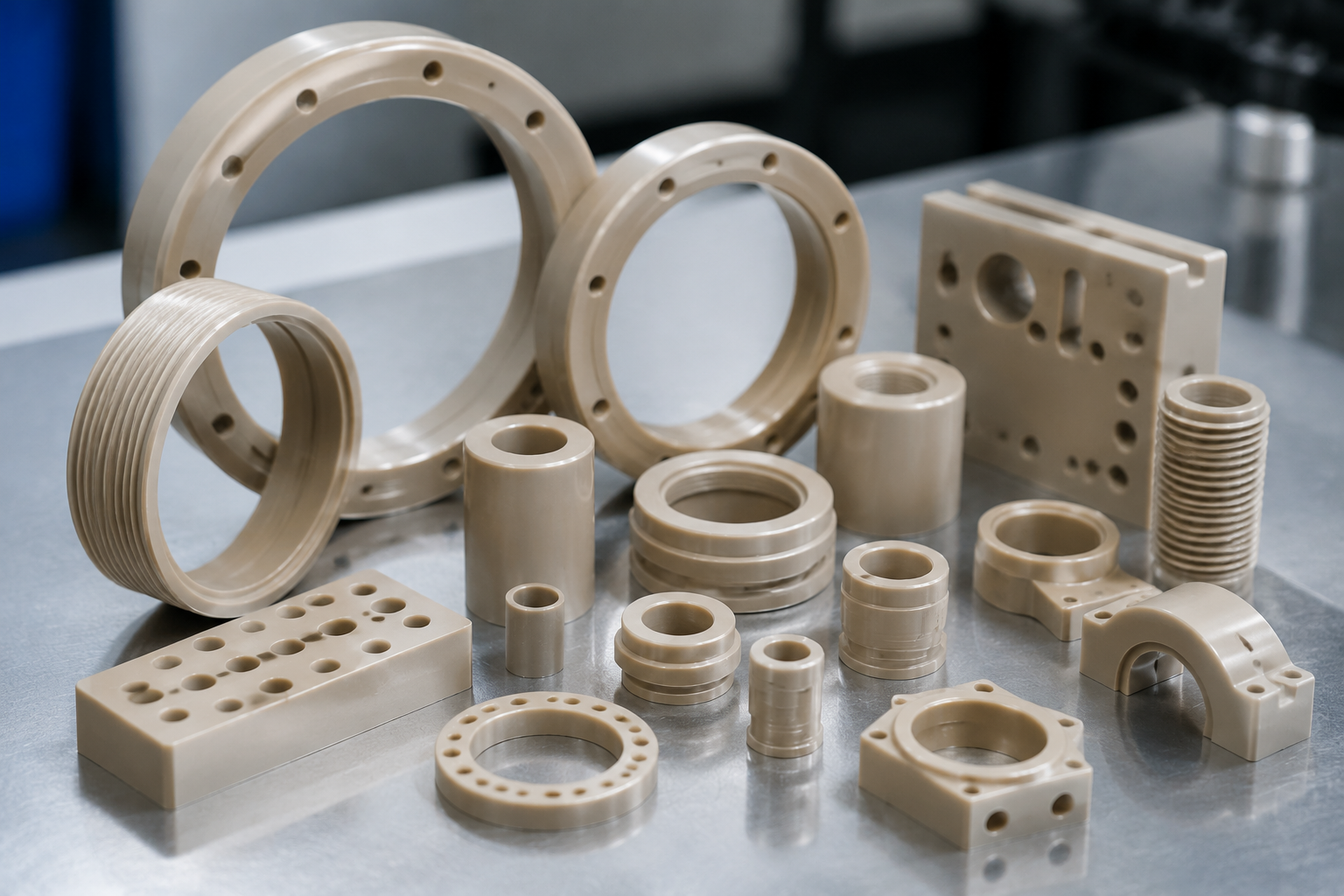
Best For
Mechanical wear dampening, electrical insulation fixtures, chemical-resistant sliding seals, and lightweight prototype structures.
Buyer should send
3D STEP files plus 2D PDF drawings highlighting exact polymer grade and tight tolerance requirements.
Engineering reviews
Thermal expansion, warp risk, corner radii, stress cracking, and moisture absorption limits.
Material Grade & Property Comparison
Reference values for engineering properties, thickness impacts, and environmental resistance.
| Polymer Grade | Strength Level | Service Temperature | Chemical & Wear | Dimensional Stability |
|---|---|---|---|---|
| PEEK Natural (Unfilled) | High, tensile 100 MPa | Max 250°C | Outstanding; FDA compliant and biocompatible | Excellent; very low creep at high temperature |
| PEEK GF30 | Very high, tensile 150 MPa | Max 250°C | Outstanding electrical insulation | Outstanding; enhanced flexural modulus |
| PEEK CF30 | Extremely high, tensile 200 MPa | Max 250°C | Outstanding; ESD safe and low friction | Outstanding stiffness and load capacity |
Best-Fit Manufacturing Processes
Optimal for flat sliding paths, insulators, manifolds, and wear blocks in rigid thermoplastics.
Efficient for bushings, rollers, standoffs, and threaded fittings.
Suitable for low-strength design models or complex internal geometry.
Surface Finish Compatibility
Common post-machining surface treatments compatible with this material class.
As Machined
Parts are deburred. Tool marks remain visible and dimensional precision is preserved.
Bead Blasting
Light blasting can create a clean matte cosmetic texture on rigid plastics.
Textured Finishes
Tumbling or blasting improves cosmetic consistency; chemical color options are limited.
Polishing / Buffing
Mechanical polishing reduces roughness for semi-gloss or clear parts.
Procurement & Purchasing Notes
Key technical points to address on drawings to ensure immediate manufacturing alignment.
| Area of Review | Engineering Guidelines | Why it Matters / Notes |
|---|---|---|
| Material Traceability | Raw material certification (MTR) checked against alloy composition profiles. | Confirms the raw stock grade before machining starts. Available upon request. |
| Drawing Controls | Toleranced dimensions checked on 2D PDF drawings. | Standard machining tolerance applies to unmarked features; critical tolerances must be highlighted. |
| Coating Allowance | Layer thickness buildup for anodizing, plating or powder coating is evaluated. | Specify whether drawing dimensions apply before or after coating to avoid interference. |
Technical Updates
Material FAQ
Which plastic is best for high temperature?
PEEK is suitable for continuous service up to about 250°C; PTFE also handles high temperature with lower structural strength.
How do we control deformation in plastic machining?
We manage drift through stress relief, sharp tooling, and controlled cutting parameters.
Are engineering plastics chemical resistant?
PEEK and PTFE are highly chemical resistant; POM is strong against many fuels and solvents but sensitive to strong acids.
Send drawings for review
Upload your STEP/STP files. Our engineering team reviews tolerances, threads, and material routes before pricing.